
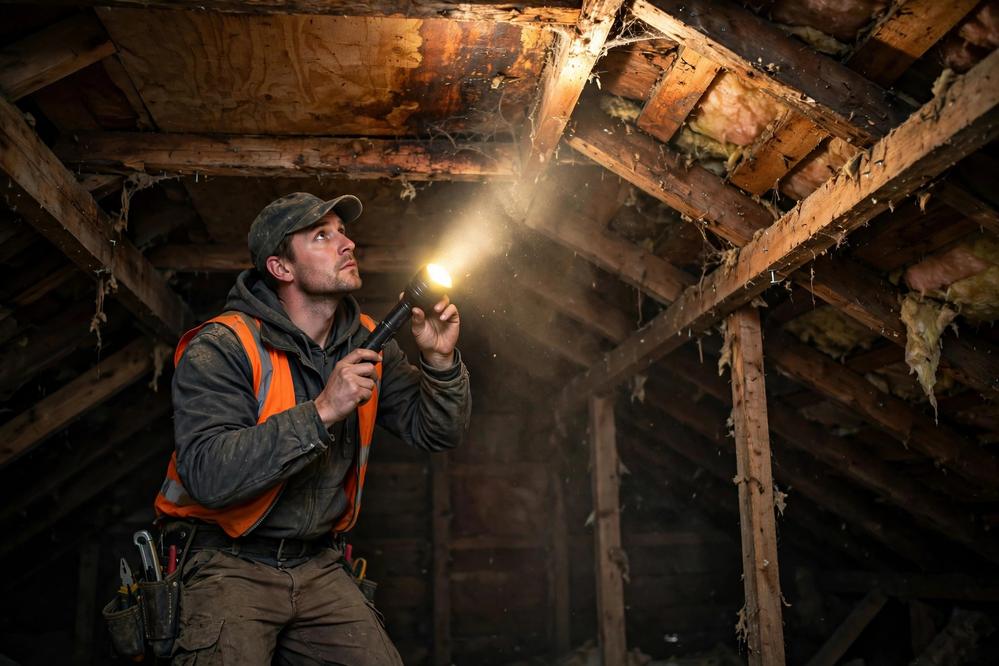
Start in the attic, not on the roof
The attic underside is the best map of a roof leak you will ever get. The roof surface hides water paths; the attic shows them, as staining on the deck, damp insulation, and trails that lead back toward the entry point. That is why a proper roof leak detection visit starts inside, and why homeowners who climb onto the roof first often fix the wrong spot.
Before you go up, be honest about safety. Attics in Northridge ranch homes are often low, hot, and cramped, with insulation hiding the joists. Step only on joists, never on the ceiling below. Take a bright torch, not a phone light. If the deck feels soft, the space is too tight to move in, or wiring crosses your path, stay out and call for an roof inspection instead.
What water does once it gets in
Water almost never drops straight down. It enters at a flashing, a valley, a vent, or a pipe boot, then runs along the deck or a rafter until gravity wins, sometimes well away from the entry point. That is the single most useful fact in leak hunting: the stain marks where water gave up, not where it got in. Chasing the stain upward and outward, along the slope, is how you find the source.
In Northridge, the usual suspects follow the local pattern. Flashing at chimneys, walls, and skylights cracks under summer heat and fails in winter rain. Pipe boots split under UV. Valleys collect debris and slow water until it finds a seam. And on tile roofs, the underlayment beneath the tile is often the real failure, even though the tile looks fine from the street.
A step-by-step attic check
- Go up during or just after rain, if it is safe to do so. A dry attic hides a leak that a wet attic reveals.
- Look at the underside of the deck above and uphill from any ceiling stain, following the slope upward.
- Check every penetration from below: plumbing vents, exhaust vents, skylight wells, and the chimney breast.
- Look for daylight. Any pinprick of light at a penetration or seam is a hole rain can use.
- Check insulation for damp patches and the deck for dark staining, and photograph everything from a safe position.
- Note rust on nails and any mould or mildew growth, which point to a leak that has been active for a while.
What the attic can tell you about the whole roof
An attic check is also a ventilation check. In Title 24 Climate Zone 9, poor ventilation cooks the deck from below in summer and traps condensation in winter, and both shorten roof life. If the attic is stifling in summer, or you see condensation staining, ask about ventilation installation and roof vent installation when you call. Ventilation will not fix an active leak, but it protects the repair you pay for.
The same visit can reveal whether a leak is isolated or systemic. One stained rafter near one vent is a repair. Staining in several bays, soft decking, or underlayment that crumbles points to a roof near the end of its service life, and the honest next step is a written quote for roof replacement to compare against repeated repairs.
When to stop looking and call
Stop and call Dravon Pulse Roofing at (424) 255-3700 if water is coming through a ceiling, the stain is growing between visits, you cannot see a clear entry point, or the attic is unsafe to move in. We are open 24 hours, every day. A roofer will trace the leak from the attic outward, photograph the failed detail, and give you a written quote for the repair. If you live near Northridge West or anywhere else in Northridge, the method is the same, and the first job is always to stop the water.