
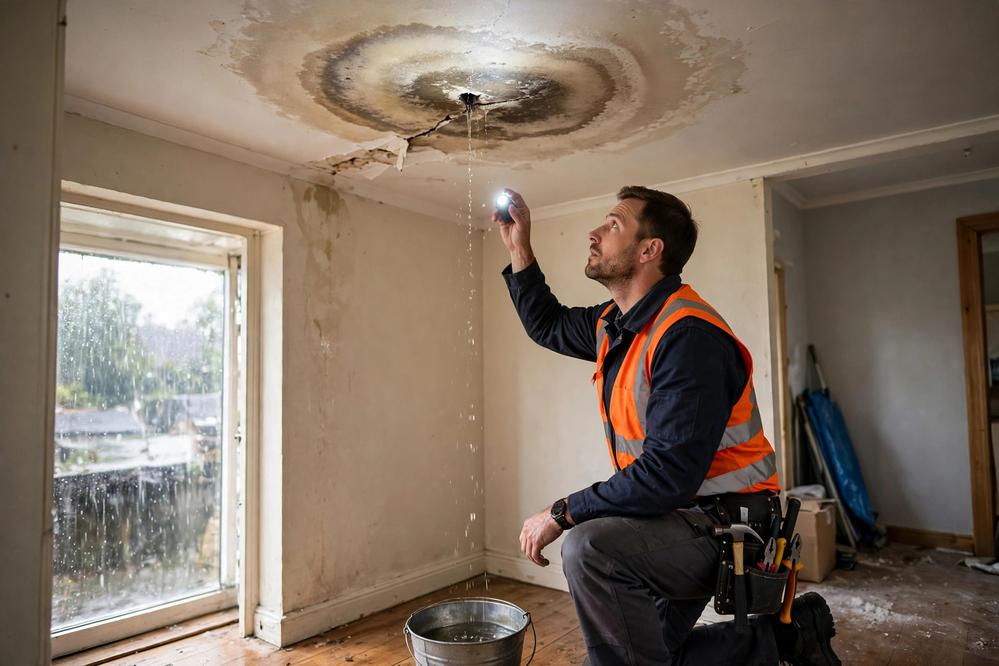
Rain does not create most leaks. It reveals them
Northridge rain arrives in concentrated winter bursts, with February typically the wettest month at about 3.4 inches. A roof that survived a dry summer can start dripping in the first real January rain, and homeowners understandably blame the storm. In most cases, though, the storm only exposed a detail that had already failed: a flashing that cracked in summer heat, a pipe boot that split under UV, a shingle edge lifted by a Santa Ana wind weeks earlier, or a gutter so full that water backed up under the eaves.
That distinction matters, because it decides what the fix is. Sealing the ceiling stain does nothing. Finding the entry point does everything. Water rarely drops straight down; it travels along the deck, a rafter, or a pipe before it shows itself, which is why the stain on the ceiling is often metres from the hole in the roof.
The four entry points we check first
Flashing comes first. Step flashing at walls, counterflashing at chimneys, and flashing around vents and skylights are the most common leak sources on Northridge roofs, and they fail quietly: a crack opens, a seal shrinks, a piece rusts through, and nothing shows until rain finds it. Our roof flashing repair page explains what a proper flashing repair involves, and our chimney flashing repair page covers the chimney transition specifically.
Pipe boots come second. The rubber boot around a plumbing vent hardens and splits in Valley sun, and the split lets water run straight down the pipe. It is a small part and a common leak, and it is easy to miss from the ground because the boot looks intact until you are close to it.
Valleys and drainage come third. Valleys carry the most water on any pitched roof, and debris in a valley slows that water until it finds a seam. Gutters are part of the same story: when gutter cleaning is overdue, water backs up under the first course of shingles and rots the fascia.
Shingle damage comes fourth. Shingles lifted by Santa Ana wind, or curled by years of heat, leave gaps that wind-driven rain exploits. If the damage is widespread rather than isolated, the honest conversation is about roof replacement rather than another patch.
What to do while the roof is still wet
- Contain the water inside: buckets, towels, and moving furniture and electronics out of the drip line.
- Photograph the stain, the drip, and any visible roof damage from the ground. Photos help a roofer and, if relevant, your insurer.
- Do not climb onto a wet roof. Wet shingles and tile are slick, and a fall costs far more than a leak.
- Call for help early. Dravon Pulse Roofing is open 24 hours, every day, and the first job on an active leak is to stop the water, not to sell a new roof.
How a leak is actually traced
A proper roof leak detection visit starts in the attic, not on the roof. The attic underside shows water paths, staining, and daylight that the roof surface hides. From there, the roofer works outward to the flashing, valleys, vents, and penetrations above the stain, checking each candidate detail rather than guessing. Moisture checks help where a leak is suspected but not visible. Only then does roof leak repair make sense, because the repair has a named target: this flashing, this boot, this valley section.
If you live in one of the neighbourhoods we cover, such as Sherwood Forest, the pattern is the same: post-war ranch roofs with ageing shingles and flashing, and tile roofs whose underlayment matters more than the tile. The roof's age and type change the repair, but the method does not change.
When a leak means more than a repair
One leak, one entry point, and a roof with life left in it: repair. Leaks in three or four places, a deck that feels soft underfoot, or underlayment that crumbles when lifted: that roof is telling you the system is done, and patching it buys months, not years. A written quote should say which situation you are in, and why, with photos to back it up. If a contractor cannot show you the failed detail, do not agree to the repair.
Call Dravon Pulse Roofing at (424) 255-3700 for an inspection or a written quote. We are open 24 hours, every day.